
You have two years.
That sounds like a lot of time.
It isn’t.
Two years can disappear between college classes, exams, holidays, social media, assignments and the occasional promise that “I’ll start seriously next month.”
Then suddenly, Intermediate is over.
And the big question arrives:
“What do I do next?”
By then, choosing a university is only part of the problem.
You also need to know what you are good at, what skills you have, what kind of work interests you, how to communicate confidently, how to use technology intelligently, and how your college education connects to your future.
That is why Intermediate should not be treated as a two-year waiting period between Matric and university.
It should be treated as your launch period.
Here is a practical two-year roadmap to make those years count.
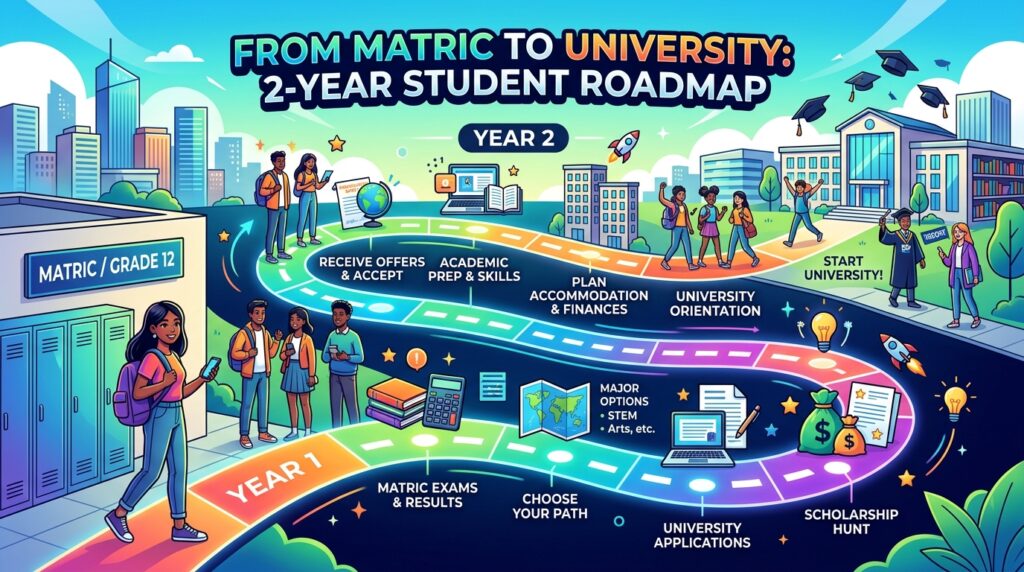
Year 1: Build Your Foundation
Your first year is not about having everything figured out.
It is about building the habits and capabilities that will make the second year easier.
1. Learn How to Learn
Your first target should not simply be getting more marks.
It should be becoming better at learning.
Create a study system that works for you. Break large chapters into smaller sessions. Review difficult concepts instead of repeatedly reading what you already know. Practise questions. Test yourself without looking at your notes.
Good grades are usually the result of a good system repeated consistently.
The goal is simple:
Don’t study harder every day. Learn how to study better.
2. Treat Your Subjects as Career Clues
Your subjects are more than papers you need to pass.
They can tell you something about yourself.
Enjoy Biology?
That may point towards healthcare, biotechnology, nutrition, laboratory sciences or other life-science pathways.
Enjoy Mathematics and Physics?
Engineering, technology, data and analytical fields may deserve exploration.
Enjoy Computer Science?
You may want to investigate software, AI, cybersecurity, data and digital technologies.
Prefer Commerce?
Accounting, finance, banking, entrepreneurship and business could become possibilities.
Enjoy languages, communication or social sciences?
There are paths through education, media, law, psychology, public administration and many other fields.
You do not have to choose your entire life in first year.
But you should start collecting evidence about what interests you.
3. Build One Skill Outside the Textbook
This is where Intermediate becomes different from traditional exam preparation.
Choose one practical skill and take it seriously.
It could be:
AI basics.
Content creation.
Graphic design.
Video editing.
Digital marketing.
E-commerce.
Freelancing.
Client communication.
The skill itself matters.
But something else matters more:
Can you actually use it?
Superior Colleges now promotes AI-integrated learning and digital skills, including AI basics, prompt engineering, design, video editing, digital marketing, e-commerce, freelancing and client handling.
That direction also reflects a larger shift in the world of work. The World Economic Forum identifies AI and big data, networks and cybersecurity, and technological literacy among the fastest-growing skill areas, while creative thinking, resilience, flexibility and lifelong learning are also rising in importance.
So don’t think:
“I am only an FSc student.”
Think:
“I am an FSc student who also knows how to use technology, communicate and solve problems.”
That is a much stronger starting point.
4. Stop Collecting Certificates. Start Collecting Proof.
A certificate says:
“I completed something.”
A project says:
“I can do something.”
That difference matters.
Instead of completing five random courses, try creating three real projects during Intermediate.
An ICS student could build a small website.
An I.Com student could create a simple business budget or financial model.
An FSc student could create a science presentation, research summary or educational project.
An FA student could create a writing portfolio, digital publication or media project.
The objective is not to become an expert at 17.
The objective is to leave college with evidence that you can apply what you learned.
5. Build Your Communication Skills
You can know the answer and still struggle to explain it.
You can have a good idea and still fail to present it.
You can have technical knowledge and still find it difficult to speak to another person.
That is why communication belongs in every student’s roadmap.
Practise:
Writing clearly.
Speaking confidently.
Presenting ideas.
Listening properly.
Asking better questions.
Working in a team.
These are not “extra” skills.
They travel with you into university, internships, interviews, entrepreneurship and professional life.
Year 2: Turn Your Foundation Into Direction
By second year, the question changes.
First year asks:
“What am I interested in?”
Second year asks:
“What am I going to do with it?”
6. Choose a Direction Before You Choose a Degree
Don’t start university research by asking:
“Which degree is popular?”
Start by asking:
“What problems do I enjoy solving?”
A degree is a vehicle.
Your interests, strengths, values and career goals determine where that vehicle should take you.
Make a simple three-column document:
| I Enjoy | I Am Good At | I Could Build a Career In |
| Biology | Scientific thinking | Healthcare |
| Technology | Problem solving | Software / AI |
| Business | Numbers & decisions | Finance / Entrepreneurship |
| Writing | Communication | Media / Education |
Your answers will not magically reveal your future.
But they will make the decision far more intelligent.
7. Start Preparing for University Before University Starts
One of the biggest mistakes students make is waiting for Intermediate to finish before thinking about university.
Start earlier.
Research programs.
Compare eligibility requirements.
Understand entrance tests.
Explore universities.
Check scholarship opportunities.
Learn about potential careers.
Talk to people studying the fields you are considering.
Most importantly, don’t choose a university simply because your friends are going there.
Your friend is not choosing your career.
You are.
Superior Colleges already positions Intermediate as preparation for university and beyond, with career counselling and university preparation included in its student offering.
8. Learn to Use AI Without Letting AI Use You
This is becoming one of the defining skills of modern education.
AI can help you explain a difficult concept, generate practice questions, brainstorm ideas, organize information and accelerate certain tasks.
But there is a dangerous shortcut:
using AI to avoid thinking.
There is a better approach.
Use AI to ask better questions.
Use it to challenge your understanding.
Use it to practise.
Use it to compare explanations.
Use it to find gaps in your knowledge.
Then do the thinking yourself.
This matters because AI is no longer limited to computer science. In March 2026, HEC stated that a three-credit-hour AI course had been made mandatory across undergraduate programmes in Pakistan, reflecting the growing importance of AI literacy across disciplines.
The future student will not simply be the person who knows how to use AI.
It will be the person who knows when to use it, how to question it and when not to trust it.
9. Do Something Real Before You Graduate
You don’t need a corporate office.
You don’t need a six-month internship.
You need experience doing something outside the classroom.
Volunteer at an event.
Join a student activity.
Work on a project.
Help organize a campaign.
Create content.
Build something.
Sell something.
Teach someone.
Take part in a competition.
Solve a real problem.
These experiences teach lessons textbooks cannot.
They teach responsibility.
Deadlines.
Teamwork.
Failure.
Confidence.
Communication.
Ownership.
That is part of becoming ready for university and professional life.
10. Your Final Six Months Should Look Different
When Intermediate is almost over, stop behaving like a student who is simply trying to finish.
Start behaving like someone preparing for the next stage.
Create your university shortlist.
Organize your academic documents.
Review entrance requirements.
Strengthen weak subjects.
Build your portfolio.
Update your skills.
Research scholarships.
Discuss realistic options with your parents and teachers.
And ask yourself one final question:
“What do I want to be better at one year from now?”
Not just:
“What degree do I want?”
Because a degree tells people what you studied.
Your skills, habits, character and experience tell them what you can do.
The Superior Student Scorecard
Before you finish Intermediate, see how many of these boxes you can honestly tick:
I can study independently.
I understand my strongest academic areas.
I have explored possible career directions.
I have built at least one practical skill.
I have completed real projects.
I can communicate my ideas confidently.
I know how to use AI responsibly.
I have participated in activities beyond the classroom.
I have researched my university options.
I know what I want my next step to look like.
You do not need a perfect score.
You need progress.
The Two Years That Can Change Everything
The biggest mistake an Intermediate student can make is thinking:
“My real life begins after college.”
It doesn’t.
It begins with the decisions you make now.
The subjects you take seriously.
The habits you build.
The skills you practise.
The people you learn from.
The projects you attempt.
The questions you ask.
The confidence you develop.
And the direction you begin to understand.
Finance Division: Pakistan’s digital economy is also creating a stronger reason for students to develop practical capabilities alongside formal education. The Pakistan Economic Survey 2025-26 reported IT services exports of about US$3.4 billion for July to March FY2026, with 19.8% growth, while freelance-based digital services were among the contributors to that growth.
But being future-ready is not about becoming a technology expert.
It is about becoming the kind of student who can learn, adapt, communicate, create and solve problems.
That is the real purpose of your two years in college.
Don’t spend Intermediate waiting for your future.
Use Intermediate to build it.
