
After your matriculation, you probably wonder which college is right for you, and you have already searched for it or listened to your relatives and neighbors as well. But let me tell you a secret. A college that boosts your potential and polishes your talent is Superior College. Our programs are designed to lift up talented students like you. If you want to become a doctor, a software engineer, or go into hardware engineering, you should have the polished skills to earn well for your future.
But there are many gaps in our education system. Let’s get real: we are preparing our students for exams, not for life, which will lead them nowhere, and it’s a major growth gap. It’s time for us to dive a little deeper to understand what’s behind the curtains.
Education Gaps in Pakistan: Evidence and Insights
The very first outdated thing is our educational curriculum.
A consistent theme is that curricula lag behind market needs. For instance, the British Council’s 2024 analysis of Pakistan’s IT sector warns that many programs have “outdated or irrelevant curricula that do not align with the evolving needs” of industry. Likewise, the HEC and industry leaders have urged universities to “update academic curricula to match current global requirements” in order to develop skilled human resources. In practice, many college courses still emphasize rote memorization of facts rather than emerging subjects (AI, data science, etc.).
Assessment Practices: Traditional assessment remains heavily exam-oriented. A recent Pakistan Today analysis notes that despite semester reforms, “universities still struggle to move beyond memorization-based questions” and often lack rigorous checks on assignments. This means students are seldom tested on problem-solving, critical thinking or real competence. (Indeed, the rise of AI tools like ChatGPT has exposed that many take-home essays can be easily fabricated.) Without robust assessment – such as oral defenses, project-based work or quality moderation – genuine learning cannot be confirmed. In short, rote assessment undermines the development of creativity and practical skills.
Practical Skills & Employability: Pakistani colleges often lack hands-on training or industry links. As one news report explains, the gap between “academic knowledge and the practical skills required by today’s job market” is so large that the HEC now requires internships and professional certifications for all undergraduates. However, many institutions still treat internships as a formality, without structured industry mentoring. Similarly, studies find that graduates lack specific digital and entrepreneurial skills. For example, an Economist Impact survey reports that 57% of Pakistani employees say digital skills are their top priority to acquire, reflecting a booming IT and freelancing economy. Yet universities rarely integrate such training (sad reality). A TechValley-Punjab report notes the government’s new push (100,000 Google Career Certificate scholarships) precisely to give students “the exact tools they need to solve real-world problems”.
Career Guidance & Inclusion: There is also insufficient career counseling and support. The British Council report highlights “insufficient career counseling and entrepreneurial training in colleges, meaning students often don’t learn how to launch their own projects or adapt to industry needs.
Women and rural youth face special barriers: low female literacy and internet access mean many girls can’t benefit equally. Economist Impact found that 46% of Pakistanis still lack internet access, and only 38 million of 182 million mobile subscriptions belong to women. These gaps in equity mean that even if skills are taught, not all students can access the training.
Infrastructure & Resources: Many campuses still struggle with basic infrastructure. For example, only half of Pakistan’s secondary schools have computer labs, hinting at similar shortages in colleges. Even where digital tools exist, adoption is uneven. A news analysis points out that digital transformation in higher ed has begun, but many institutions use tech only as an add-on rather than core to teaching. In short, limited labs, slow networks, and resource gaps continue to hold students back.
AI-Powered Certification Programs – Case Studies
Education leaders worldwide are promoting AI-powered and digital-skills certifications to address these gaps. In Pakistan, the government’s DigiSkills program (run by Ignite and Virtual University) offers free online courses in freelancing and IT, with over 4.5 million enrollments since 2018. Students earn e-certificates (e.g., in digital marketing, e-commerce, Python) that strengthen their portfolio.
Similarly, in 2026, Punjab launched 100,000 Google Career Certificate scholarships across universities. This public–private partnership (Google–Tech Valley–Punjab HED) provides certificates in IT support, data analytics and a new “Google AI Professional Certificate” track. Google’s leadership explains this equips youth “with advanced AI and specialized IT training,” so they become “the innovators, builders, and leaders of tomorrow’s digital economy”.
Other international examples include AI-focused teacher training (UNESCO’s AI-in-Education program for 150 Pakistani teachers) and global online platforms (e.g, Coursera, edX, AWS/Azure badges). These certify practical skills (machine learning, cloud, programming) and often involve project work, aligning closely with market needs. The common thread is credentialed, hands-on learning that students can showcase alongside formal degrees.
Skill Priorities Among Pakistani Employees
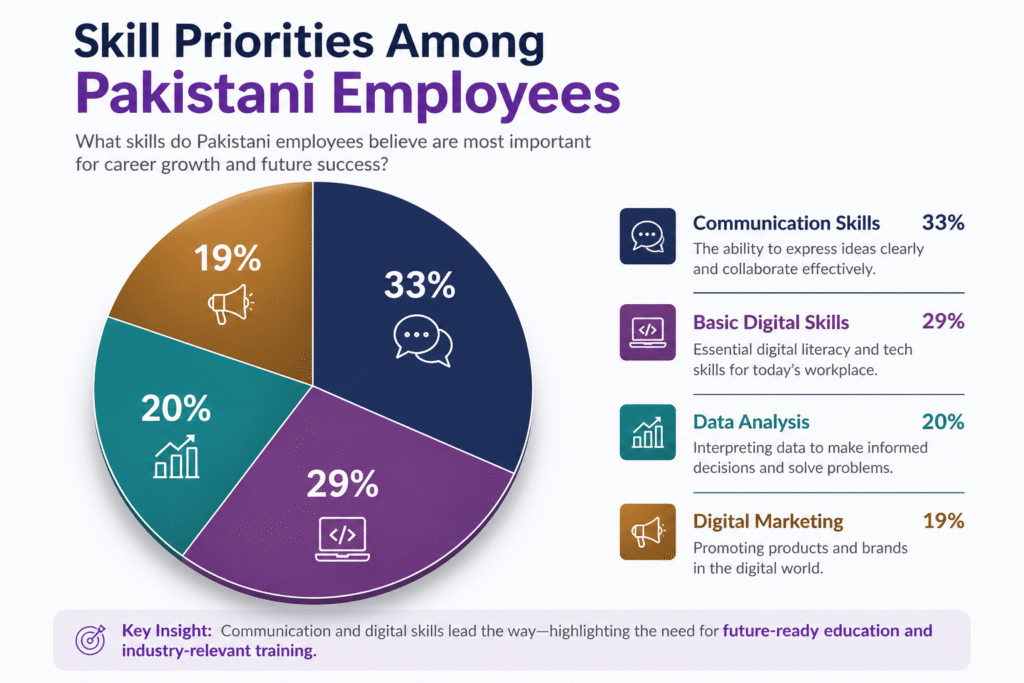
Chart: A recent survey found that over 80% of Pakistani employees consider communication skills “a must-have”, and 72% said basic digital literacy is most important. Data analytics and digital marketing also ranked high – reflecting the market’s skill demand.
Therefore, at superior colleges, we understand and bringing improved education system to make our students ready to accelerate towards achieving their dream goals. As the world is moving towards artificial intelligence (AI), let’s find out what steps superior colleges are taking for their students.
Superior Colleges’ Learn-to-Earn Model
Superior Colleges has built on these insights with its Learn-to-Earn Program for intermediate students. The program “seamlessly blends theoretical knowledge with practical expertise”, teaching freelancing and digital business skills alongside regular subjects. Students (in FSc, ICS and I.Com) learn SEO, graphic design, digital marketing, e-commerce, 3D animation and web development. Crucially, they apply this knowledge by working on real projects – even earning money for clients while still in college. Superior proudly notes that students can “generate a significant monthly income of up to 50,000 rupees or more while simultaneously pursuing their studies”.
This project-based, learn-and-earn approach directly addresses the gap between school and work. By mastering in-demand digital skills and soft skills (communication, time management, etc.), graduates leave with both a degree and marketable experience. Superior’s site emphasizes that the program “closes the knowledge gap between conventional education and practical skills”. In practice, students build portfolios (websites, marketing campaigns, sales funnels) and develop sales skills – essentially training as entrepreneurs.
This model (Product → Market → Certification) could be likened to “learn-to-earn AI certification”, where learning outcomes are validated by completed client work.
| Program / Certification | Provider | Focus Skills | Credential / Outcome | Notes / Source |
| Superior Learn-to-Earn (FSC/ICS) | Superior Colleges | SEO, Graphic Design, Digital Marketing, E-Commerce, WebDev, etc. | Superior College certificate; real freelance experience | Earn Rs. 50k/month during study; integrated with academics. |
| DigiSkills Training Program | Govt (Ignite/VU) | Freelancing Skills, Digital Literacy, Python, AI basics | E-cert from Virtual University | Free courses, 4.5M+ participants since 2018. |
| Google Career Certificates | Google / Coursera | IT Support, Data Analytics, Cybersecurity, AI Professional | Google-recognized certificate | 100k scholarships in Punjab; includes AI track. |
| Coursera/edX/LinkedIn Learning | Various (IBM, Microsoft) | Cloud, AI, Data Science, Management | Professional certificate/microdegree | Industry-endorsed courses (self-paced). |
A Roadmap to Bridging Gaps (2026–2029)
To systematically address these issues, education leaders suggest phased reforms with clear metrics. The timeline below outlines a 3–4 year roadmap:
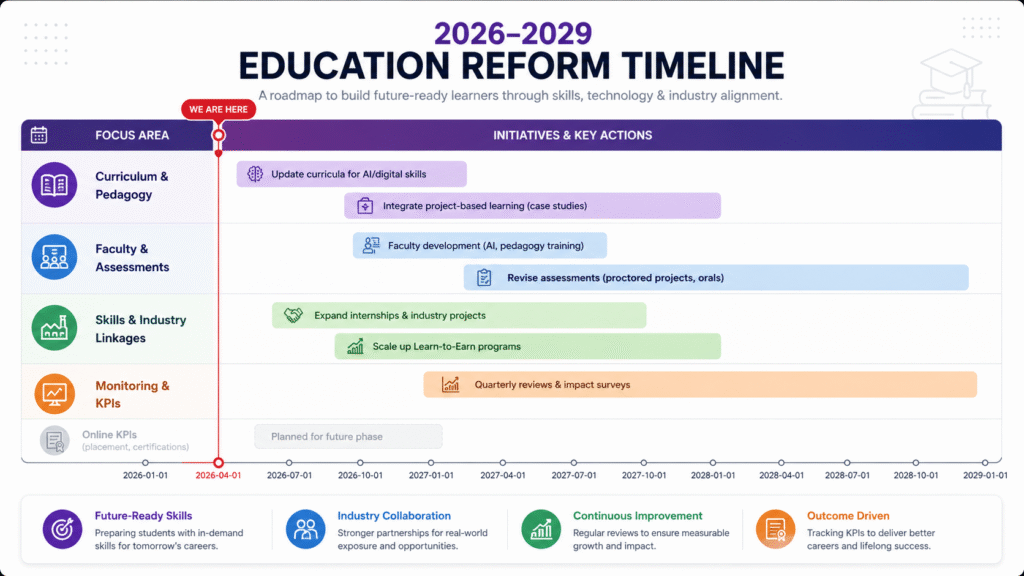
Key KPIs to measure success could include: the percentage of students completing internships; certification pass rates; average freelance or job placement earnings of graduates; employer satisfaction ratings; and gender parity in program access. Schools might track metrics like “% of graduates obtaining paid digital project work” or “average first-year salary” to ensure true skill acquisition. Regular feedback from employers and alumni (via surveys) should inform iterative improvement.
The Superior Solution – Skilled College Students
Education in Pakistan is evolving rapidly. To stay ahead of the curve, students need more than textbooks – they need hands-on training in emerging fields. Superior Colleges is meeting this challenge: along with transparent fee structures and scholarships, its programs embed digital skills, product-building and AI tools into the curriculum. As one tagline puts it, “Where Learning Transforms into Earning.”
Explore how Superior can prepare you for tomorrow’s careers. Use the Compare Programs feature on Superior’s site to find the right intermediate course (FSc, ICS, I.Com, FA) and see its fee details. Then head to the Admissions page to apply. Your journey to a Superior education and a skillful future starts today!
Frequently Asked Questions (FAQs)
Q: What exactly is the Learn-to-Earn Program?
A: It’s an intermediate (FSc/ICS/FA/I.Com) program where students learn freelancing and digital skills (SEO, graphic design, digital marketing, e-commerce, 3D animation and web development) alongside their regular studies. They complete real projects and can earn income while studying, gaining both academic credentials and work experience.
Q: How do AI certificates fit into a college curriculum?
A: Superior integrates digital/AI skills into existing programs. For example, modules on AI basics and prompt engineering teach modern tools (see PDF overview) in the curriculum. Students may also earn external certificates (Google AI Certificate, etc.) through partnerships or self-study, boosting employability.
Q: Will fees increase?
A: Superior’s official admissions guide notes that fee structures can rise “slightly due to inflation” each year. However, campuses offer merit scholarships and financial aid to offset costs. Details for 2026 fees (admission, tuition, exam charges) are outlined on the Superior admissions page.
Q: How can I compare programs and apply?
A: Visit Superior’s website to compare intermediate programs (FSc, ICS, I.Com, FA) side-by-side. Each program’s page lists subjects, scope, and associated digital-skills tracks (e.g., learn-to-earn). To apply, go to the Admission 2026 page and follow the steps (forms, documents, etc.). Early application is recommended due to high competition.
Q: How do these skills benefit my child’s future?
A: Employers increasingly value practical digital and soft skills. Surveys show 67% of Pakistani hiring managers now consider skills-based credentials over degrees. By learning AI, coding, marketing or freelancing early, students improve their chances of jobs, higher pay and entrepreneurial success. Superior’s alumni often cite improved confidence and portfolios as a direct result of such training.
